


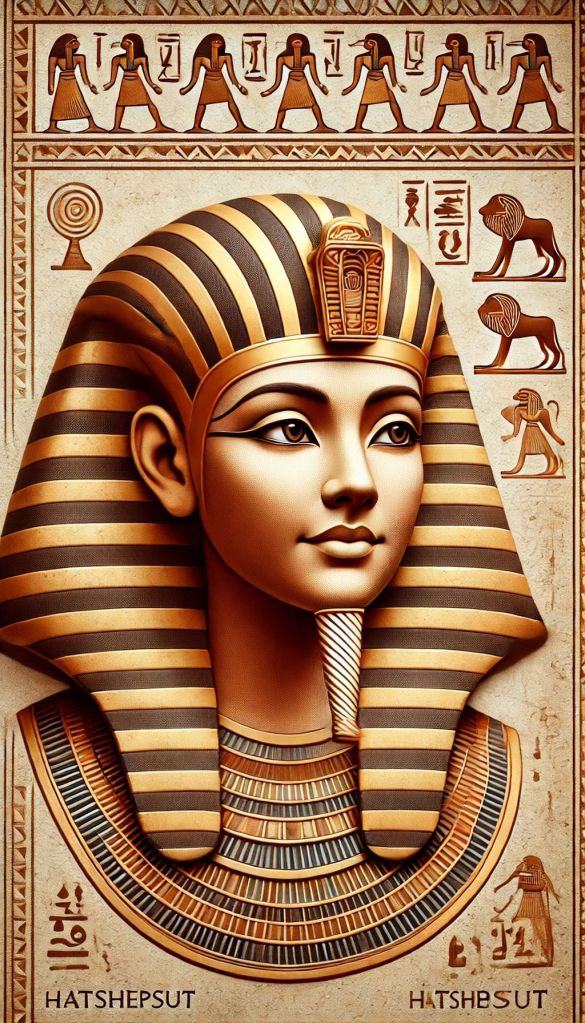
Hatshepsut, one of ancient Egypt’s most extraordinary rulers, reigned during the 18th Dynasty around 1479–1458 BCE. She broke through barriers to become the first great female pharaoh, and her legacy is carved into Egyptian monuments that still stand today. Hatshepsut’s story is remarkable, not only for her achievements but for the complexity of her reign and the challenges she faced as a female ruler in a male-dominated world.
Rise to Power
Hatshepsut was born into Egyptian royalty as the daughter of King Thutmose I. When her husband and half-brother, Thutmose II, died unexpectedly, Hatshepsut became regent for his young son, Thutmose III, who was too young to rule alone. Though traditionally, her role would have ended once he came of age, Hatshepsut did something unprecedented: she declared herself pharaoh and ruled alongside him. In doing so, she adopted full royal titles and ceremonial symbols of a king, including the false beard, headdress, and male attire.
The Icon of Prosperity
Hatshepsut’s reign was defined by stability and prosperity. She focused on improving the kingdom through monumental architecture, economic trade, and peaceful relations rather than conquest. Her most notable achievement is the construction of the magnificent temple complex at Deir el-Bahri, which remains an architectural marvel. This mortuary temple, with its grand terraces and statues, honored the god Amun and showcased her devotion to Egypt’s gods.
Hatshepsut also initiated trade expeditions, the most famous being her voyage to the Land of Punt (believed to be modern-day Somalia or Yemen). This trade mission returned with valuable resources like frankincense, myrrh, and exotic animals, greatly enriching Egypt. The images of this expedition are carved on the walls of her mortuary temple, showing the respect and admiration she earned as a successful and visionary ruler.
Ruling as a Pharaoh
To secure her position and legitimacy, Hatshepsut emphasized her divine right to rule. She claimed to be the daughter of the god Amun himself, a belief that aligned with Egyptian religious customs. Visual depictions of Hatshepsut often show her in male attire to reinforce her position and authority as pharaoh, effectively blending her identity into the role traditionally reserved for kings.
Her actions were strategic and bold. By taking on the full symbols of kingship, Hatshepsut protected her throne and safeguarded her accomplishments from political threats. She brought peace to Egypt and fostered a period of cultural flourishing.
Her Legacy and Attempted Erasure
After her death, Thutmose III assumed full control of the throne, and her legacy took a tragic turn. In an attempt to restore a male lineage, he ordered



WELCOM>>Give a rating for my site