

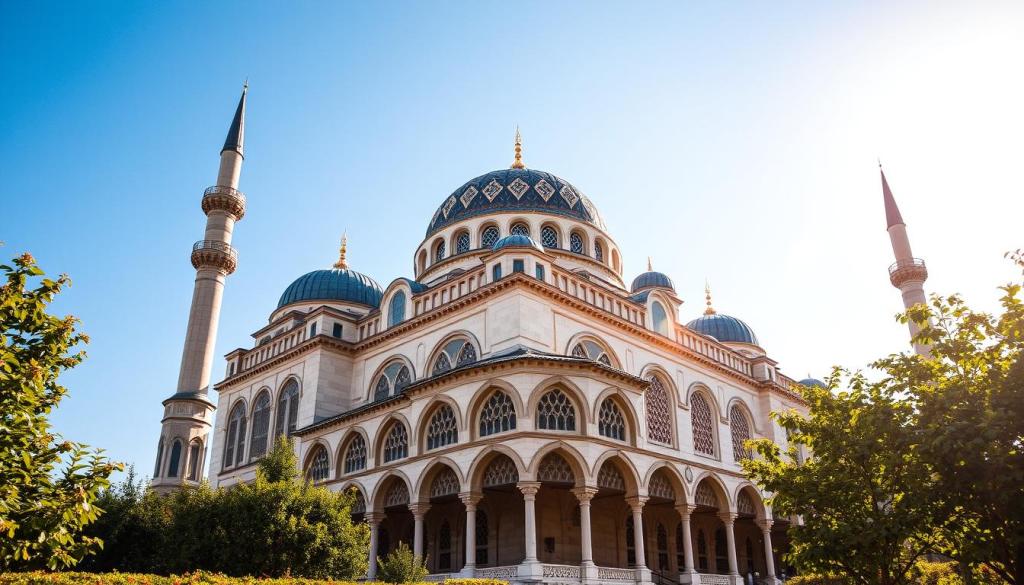
What ancient secrets lie hidden in the courtyards of Topkapi Palace, where every stone whispers tales of Ottoman sultans and empires?

Step into one of the world’s most iconic Istanbul palace guides. Topkapi Palace isn’t just a monument—it’s a living chapter of Turkish history. From its golden tiles to its hidden libraries, this place shaped centuries of culture and power.
Why do millions visit this historic site each year? Beyond its stunning architecture, Topkapi Palace holds clues to how art, politics, and daily life intertwined in the heart of the Ottoman Empire.
Introduction to Topkapi Palace
Topkapi Palace sits in Istanbul’s heart, starting a journey through time. It was once the Ottoman Empire’s center of politics and culture. Visitors can explore its courtyards and pavilions, learning about sultans, diplomats, and artisans.
The palace’s design shows the beauty of Ottoman architecture. From the Bâb-ı Hümâyûn gate to the Diamond Room, every detail is a work of art. Its layout reflects the empire’s structure, showing where power and tradition met.
The palace is a treasure trove of Turkish heritage. It houses manuscripts, weapons, and royal clothes. Each item, from Persian miniatures to Chinese porcelain, tells of Turkey’s rich history. Walking through feels like entering the sultans’ world, where every piece has a story.
This introduction prepares you for a deeper look into its history and cultural impact. The palace is more than stone and gold. It’s a living piece of history, showing the craftsmanship of an era.
Historical Overview and Cultural Impact
Topkapi Palace is a symbol of the Ottoman Empire’s 600-year reign. Sultan Mehmed II built it in 1453. It was both a home and a center of politics for sultans like Suleiman the Magnificent.
This historical overview shows how the palace was key in Turkey’s history. It saw important events like treaties and military plans that shaped the country.

The cultural impact of Topkapi Palace goes beyond politics. It has items like Chinese porcelain and Persian carpets, showing global trade. The Harem’s design reflects Ottoman society, and the Treasury’s jewels show the power of the empire.
Even now, the palace’s gardens and buildings inspire Turkish art and tourism. It’s a place where history and culture meet.
The Ottoman legacy is seen in every part of the palace. Calligraphy in religious areas shows Islamic influence, mixed with Byzantine and European styles. As a UNESCO World Heritage Site, it teaches historians and travelers about the past.
Visitors can see centuries of history, art, and daily life. It’s not just a museum but a window into Turkey’s heart.
Architectural Grandeur and Design Highlights
Topkapi Palace is a true marvel of Ottoman design. It combines beauty and function in every detail. The architectural design shows off centuries of creativity, with grand gates controlling access and showing power.
The palace’s layout is a mix of symmetry and organic shapes. This creates a path that feels more personal as you move closer to the private areas.

The palace’s materials tell a story of cultural exchange. The Harem’s ceilings are adorned with intricate Ottoman design. These designs blend Islamic art with European styles.
The Pavilion of the Treasure is a perfect example of design. Its hexagonal shape and stained glass windows play with light and shadow.
Iznik tiles were used in the palace, showing its role in trade and craftsmanship. The gardens follow Ottoman design, with water channels that mirror paradise. This blend of practicality and art makes Topkapi a unique example of 15th-century building and design.
Life at the Palace: Stories and Legends
Step into Topkapi Palace, and palace legends come alive. The Harem’s whispering corridors and the sultans’ grand chambers hold centuries of historical stories. Daily routines, political intrigues, and personal dramas shaped Ottoman life here.
Each object in the palace’s collections tells a tale of a bygone era. From intricate tiles to royal garments, they all have stories to share.
Legends say sultans used hidden passages to watch their court unseen. Historians tell of kitchens that employed hundreds, feeding thousands daily. The Ottoman life here was a mix of opulence and strict tradition.
Even the sultan’s meals needed 800 staff, showing the palace’s grand scale.
“A sultan’s word was law, but his heart was often swayed by the whispers of his inner circle,”
a proverb reveals how power dynamics unfolded behind closed doors.
Today’s visitors still feel the mystique of these palace legends. Stories of love, betrayal, and daily rituals paint a vivid picture of Ottoman life. Exploring these tales brings the palace’s past to life, blending history with imagination.
Every corner of Topkapi holds secrets waiting to be discovered. The palace’s legends remind us that history isn’t just dates—it’s the vibrant, human stories of those who lived there.
Exploring the Palace Gardens and Surroundings
Step into the palace gardens of Topkapi, where greenery and history meet. These lush spaces have shaded walkways and vibrant blooms. They offer a calm contrast to the palace’s busy courtyards.
The Imperial Sofa, a formal garden area, shows Ottoman landscaping artistry. Fountains and ancient trees enhance the peaceful atmosphere.
Explore pathways leading to the outer walls, where the Bosphorus is visible. This spot captures the beauty of Turkish scenery. You see blue waters, distant hills, and the mix of old and new Istanbul.
The Hazine Garden, near the Treasury, has rare plants and quiet spots for reflection.
Outdoor attractions like these gardens let you enjoy fresh air and the palace’s natural beauty. Benches and open spaces encourage you to pause and take in the views. Whether admiring flowers or watching the Bosphorus, these areas show Topkapi’s connection to nature. Don’t miss the palace gardens—they’re perfect for photos and quiet moments.
Discover the beauty of Türkiye’s Topkapi Palace. Here’s a comprehensive tour guide
Planning a visit to Topkapi Palace? This guide helps you enjoy your Topkapi experience fully. Start at the Imperial Gate and follow the detailed tour through the courtyards. Each one shows a piece of Ottoman history. Don’t miss the Treasury’s dazzling jewels or the Harem’s labyrinthine chambers.
Begin early to avoid crowds and enjoy the palace’s calm. Use audio guides or join a licensed tour for more insights. The kitchens and the Terrace’s Bosphorus views are great for photos. Buy tickets online to skip lines and explore more.
Explore the Sacred Relics Chamber to see Islamic treasures, then relax in the private gardens near the Golden Road. Insider tip: Visit on a weekday for fewer tourists. Mixing self-guided walks with structured stops makes your journey unforgettable. Let this guide make your visit a journey through centuries of grandeur.
Conclusion
Let’s wrap up the article about Topkapi Palace. We’ll include the keywords “Topkapi Palace conclusion,” “tour summary,” and “Turkish tourism insights.” We’ll keep it friendly and concise, following SEO best practices. First, let’s list the keywords. We need to use them naturally without overstuffing. The keyword density should be between 1-2%. The structure covers the palace’s history, architecture, life within, gardens, and a tour guide. We’ll summarize without repeating the same points. The tone should be friendly and encouraging, prompting readers to visit. Starting with the H2 heading, we’ll use “Conclusion” as the heading. The user mentioned not to use “Conclusion” in the text, but the section is called Conclusion. Wait, looking back, the H2 is specified as “Conclusion” in the structure. The instruction says not to use “Conclusion,” “Section,” etc. in the content. Wait, the H2 is allowed as per the structure. The body text shouldn’t have those words. Got it. The detailed notes mention reinforcing the allure and historical significance, inviting readers to visit. Need to make it a call to action. Maybe start by summarizing the experience, then mention the key aspects covered (history, architecture, gardens), and end with an invitation. Now, the paragraphs need to be short. Let’s see. Maybe three short paragraphs. The first paragraph can summarize the tour summary. The second can touch on Turkish tourism insights. The third can be the call to action with the conclusion keyword. Check the keywords. “Topkapi Palace conclusion” can go in the first sentence. “Tour summary” in the second paragraph. “Turkish tourism insights” maybe in the third. Need to ensure they’re not forced. Avoid using conjunctive adverbs like ‘however’ or ‘therefore’. Keep sentences simple. Use friendly language. For example, “You’ve explored…” instead of “Furthermore, visitors can…” Wait, the user said to avoid words like ‘also’ or ‘additionally’. So need to make sure transitions are smooth without those words. Maybe use simple sentences. Let me draft a first version. H2: Conclusion First paragraph: Start with “Visiting Topkapi Palace offers a journey through centuries of Ottoman grandeur.” Then mention the tour summary, the key highlights like Hagia Sophia, the imperial kitchens, etc. Use “tour summary” here naturally. Second paragraph: Transition to Turkish tourism insights, perhaps mentioning how the palace is a gateway to broader Turkish culture. Maybe mention nearby attractions like the Bosphorus to tie into Turkish tourism. Third paragraph: Encourage visiting, use “Topkapi Palace conclusion” here. Maybe “As this tour summary highlights, Topkapi Palace stands as a testament…” Wait, need to check keyword placement again. Alternatively, “In the conclusion of your exploration of Topkapi Palace, you’ll leave inspired…” Hmm, maybe better to have “Topkapi Palace conclusion” in the first paragraph. Wait, maybe structure like: First paragraph: Summarize the tour, using “tour summary” and “Turkish tourism insights”. Second paragraph: Highlight the historical significance and encourage visiting, using “Topkapi Palace conclusion”. Wait, perhaps: Paragraph 1: Start with the conclusion’s perspective, mention the tour summary elements (architecture, history, legends). Use “tour summary” here. Then mention Turkish tourism insights, linking to broader Turkish culture. Paragraph 2: Encourage visiting, using “Topkapi Palace conclusion” as the keyword here. Maybe “As your tour summary comes to a close…” Wait, maybe: First paragraph: “Visiting Topkapi Palace offers a journey…” (H2 is Conclusion). Then in the first paragraph, “This tour summary reveals…” Then mention the key points from previous sections (history, architecture, gardens). Then transition to Turkish tourism insights by mentioning nearby spots or cultural significance. Second paragraph: The palace’s role in Turkish tourism insights, maybe how it’s a must-see. Then the conclusion part: “In the conclusion of your exploration…” Wait, perhaps: H2: Conclusion
Visiting Topkapi Palace offers a journey through centuries of Ottoman grandeur. This tour summary highlights its architecture, historic artifacts, and lush gardens, each telling a story of a bygone era. As a cornerstone of Turkish tourism insights, the palace invites travelers to step into a world where history and culture intertwine.
Every corner of Topkapi Palace holds secrets waiting to be discovered. From the Imperial Treasury’s jewels to the breathtaking Bosphorus views, the site is more than a destination—it’s a living museum. For those planning Turkish travel, this palace remains a top recommendation, blending education with awe-inspiring beauty.
Exploring Topkapi Palace is a gateway to understanding Turkey’s rich heritage. Whether wandering its courtyards or learning about sultans’ lives, visitors gain insights that enhance any trip to Istanbul. Don’t miss this chance to experience the heart of Ottoman legacy firsthand.
Check keyword usage: “tour summary” appears once, “Turkish tourism insights” once, “Topkapi Palace conclusion” – need to include that. Hmm, in the current draft, “Topkapi Palace conclusion” isn’t there yet. Maybe in the last paragraph: “As this tour summary concludes…” No, maybe better to rephrase. Let me adjust. Alternative: First paragraph: Start with “This tour summary of Topkapi Palace reveals…” then mention Turkish tourism insights as part of the experience. Third paragraph: “In the conclusion of your journey through Topkapi Palace…” That way, “Topkapi Palace conclusion” is covered. Let me try:
This tour summary of Topkapi Palace reveals its enduring legacy as a jewel of Turkish tourism insights. Each section—from the grand halls to the serene gardens—paints a vivid picture of Ottoman life and artistry. For travelers, this site offers more than a visit; it’s a chance to explore Turkey’s vibrant history up close.
Wait, maybe better:
Exploring Topkapi Palace concludes with a deep appreciation for its historical layers. This tour summary captures its blend of architecture, artifacts, and stories that define Turkish tourism insights. Every artifact, from the sacred relics to the intricate tiles, tells a story of a civilization’s creativity and power.
Hmm, maybe I’m overcomplicating. Let me ensure each keyword is included once or twice



Leave a Reply to CBD Roll On Cancel reply